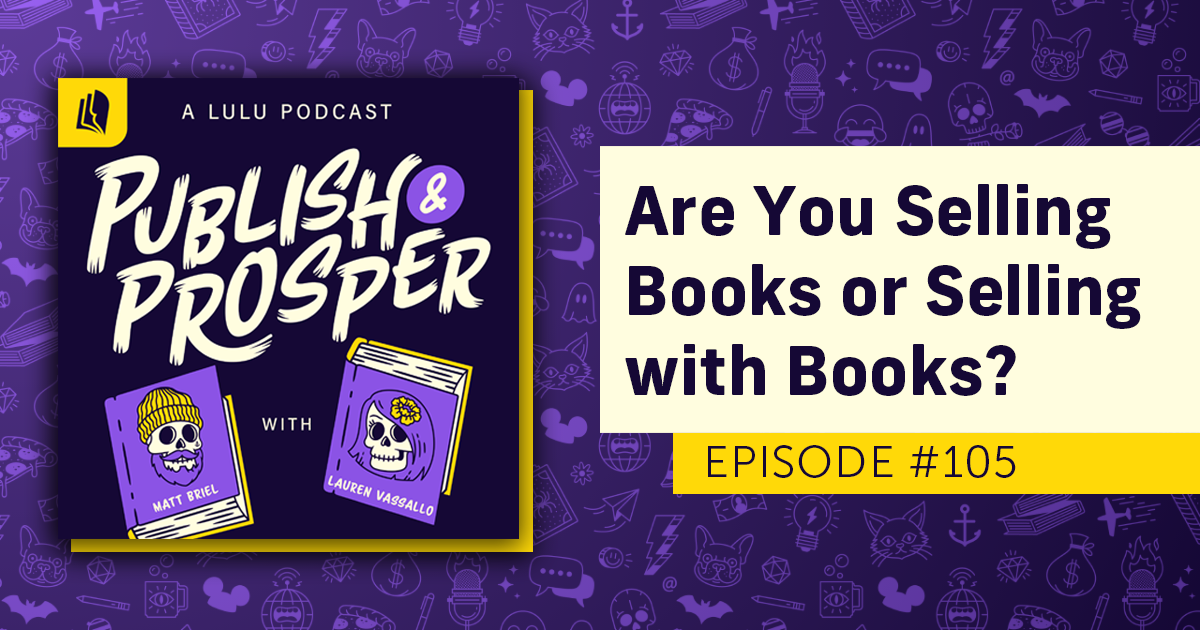
Are You Selling Books or Selling with Books?
Publish & Prosper Episode #105
Published February 4, 2026
Listen on: Apple Podcasts | Spotify | YouTube | Complete List of Channels
Books can be the product or the tool that helps sell the product…and sometimes both. In this episode, Matt & Lauren explore how print-on-demand empowers creators and businesses to use books to build their business, earn revenue, generate leads, and fuel brand growth.
Episode Chapters
- [2:09] - 3 Reasons Businesses Dismiss Books
- [6:05] - Debunking the 3 Reasons Businesses Dismiss Books
- [15:00] - Using Books as a Product
- [25:39] - Using Books as a Marketing Tool
- [40:12] - Multi-Purpose Uses for Print-on-Demand Books
- [45:18] - Episode Wrap Up
💡 Listen to These Episodes
- Ep #33 | Books You Can Create Using Your Existing Content
- Ep #58 | Creative Ways to Use Print-on-Demand to Support Your Business
- Ep #54 | Can Books Add Value to Your Business (Beyond Just Revenue)?
💡 Read These Blog Posts
💡 Watch These Videos
💡 Learn More About
Complete Episode Transcript
Matt: Welcome back, everyone, to another episode of Publish & Prosper.
Lauren: Yes, that is the name of our podcast.
Matt: Yeah. Just for a brief second, I was thinking about renaming it.
Lauren: Sure. Why not?
Matt: That’s the kind of mood I’m in.
Lauren: I... Isn't that kind of mood you’re always in?
Matt: No. Not always.
Lauren: Okay.
Matt: Not always. I do like to change things up. Today, believe it or not, we're talking about something else other than how I like to change things up on the fly. We're going to be talking about the versatility of books, and more specifically, the two main ways books are positioned or used. Either as a product to be sold. Or, which we've seen a lot more of in the last...you know, five years, for sure. Using books as a marketing tool. As a lead magnet, as a business generator. So we're going to talk about the two ways you're either selling books or you're selling with a book.
Lauren: Of course, there is technically the third option of and.
Matt: Yes.
Lauren: So, you know.
Matt: That's true, okay.
Lauren: We are not saying that these are mutually exclusive.
Matt: It’s not an or.
Lauren: Yes.
Matt: It can be an and.
Lauren: But there are still kind of differences in how you're going to approach the creation, the product type, the marketing, maybe even the selling of them. Depending on whether or not your, your primary goal is to use this as a, a revenue driver, a product type. Or to use it as a marketing tool, as a lead gen tool, as a way to maybe make some passive revenue as a secondary goal, but more likely to be the thing that, that brings new people into your business or brand.
Matt: Yeah. Yeah. Yeah, I like that.
[2:09] - 3 Reasons Businesses Don't Consider Books
Lauren: So a couple of things that we see people talking or we hear people talking about – it did that last time too. Someone just wants to hang out with us, it’s fine.
Matt: It’s a ghost host. There's room for one more.
Lauren: Some of the really common, kind of hesitations or pain points or reasons that we see people saying that, that they don't think that books would be a really viable option for them, whether it's as a product type or as a marketing tool, kind of boils down to like three main things, really.
Matt: Okay.
Lauren: Number one, the idea of a book. People hear the word book and they automatically go, well, I'm not a writer. I'm not writing a whole book.
Matt: Right.
Lauren: I'm not, I’m not going to write out this whole book.
Matt: Yeah. The idea or the notion that book means you have to actually write this long form piece of content.
Lauren: Yes.
Matt: Yep. Got it.
Lauren: Yep.
Matt: Yeah.
Lauren: Books are expensive. Whether that's to produce them, because you're placing a bulk offset print order, to warehouse them, distribute them. And then, of course, you know, when you're left over with inventory.
Matt: Yeah.
Lauren: If you don't sell through or use all of the ones that you ordered, you're just eating the cost of that.
Matt: That's correct, right.
Lauren: And then three, notoriously books are slow to market. And we referenced in an episode recently, where you were talking about someone that was going between publishing deals, whether traditional publishing option –
Matt: Yeah.
Lauren: – or self-publishing, and it was a book about AI, and they were being offered a publication date in 2027 for traditional publishing. So if you are, if your brand or your business model or anything like that is something that needs that speed to market and you're concerned that the content that you're putting out there would not get out there fast enough and would be obsolete by the time your books were printed and delivered. Then there's no point.
Matt: I mean, listen, we may be obsolete in 2027.
Lauren: Yeah. So, you know, those are, those are kind of some things that we hear from people a lot, probably the three main ones. And so we figured we would take some time to debunk those a little bit. And then talk about the different ways that we've seen brands, small business owners, large businesses, whoever, using books as a tool to support their brand, whether it is as a revenue tool or as a marketing tool.
Matt: You have the three that you just laid out as kind of like the main pieces of pushback that you get or hear, or arguments against, you know, books for certain things or for certain reasons. I would go so far as to say there's either a fourth or there is an addition to that third one. Which is, you know, a lot of people will say, oh, you know, write a book and, but if, if I publish it traditionally or, you know, for any other number of reasons, it's slow to market. There's also the notion that books in general, especially print books – because we're going to be talking mostly about print anyway, so we should be clear about that – are just outdated.
Lauren: Yeah.
Matt: Right? Like, I've talked to a lot of people that are like, well, well, I'll just, I'll just make that downloadable ebook, i.e. a PDF. Well, newsflash, nobody wants your piece of junk PDF. Nobody wants to give you their email so you can email them a crappy three page PDF that you're calling an ebook. That's not an ebook, by the way. So there is this again, I don't know if it's a fourth one or if it falls in that third category around slow to market, outdated, irrelevant, whatever, whatever. But there is this pushback you get as well that, well, if it's not digital, I don't want it.
Lauren: Yeah.
Matt: Or if it's not digital, it's not going to sell. If it's not digital, nobody's going to give me their email address to – So, I think that should be also noted.
Lauren: That's a very fair point.
[6:05] - Debunking the 3 Reasons Businesses Dismiss Books
Matt: Okay.
Lauren: But.
Matt: So.
Lauren: Yeah?
Matt: Does this mean I have to write a book? Like I have to be a writer? I have to write a book.
Lauren: Absolutely not.
Matt: It's hard.
Lauren: It is hard.
Matt: It's a lot of work.
Lauren: Between the two of us only one of us in this room has actually written a book. And it's not the person who went to grad school for it.
Matt: Maybe that's the problem.
Lauren: Maybe it is.
Matt: Maybe, maybe you're overthinking it.
Lauren: Maybe. Maybe that is exactly the problem.
Matt: Maybe I under-thought it.
Lauren: I think you gave it just the right amount of thought.
Matt: We'll see.
Lauren: But no, no, you do not have to write a book. There are plenty of different product types that you can create that are, that are books. Whether it is something that you're just taking your existing content and organizing it into a physical print product. Or maybe it is mostly photos, or art, or diagrams or, something like a workbook or a guided journal that is –
Matt: Yeah.
Lauren: – very low or no content. It could also be something that is just like a...you know, like a sampler of your existing work.
Matt: My son is a tattoo artist. He can take fifty of the flash sheets that he's designed and turn those into a book for other tattoo artists to use as –
Lauren: Yeah.
Matt: – you know? Which a lot of them do, by the way. So –
Lauren: Yeah we’ve, we’ve seen those –
Matt: I mean, there's a lot of things –
Lauren: Plenty of, yeah.
Matt: – you’re right, where you don't really have to sit down and write, you know, your opus. Like, you don't have to spend two years on a whole 80,000 word –
Lauren: Right.
Matt: – you know, manifesto, if you will. Yeah, I don't know. I just, I don't, I don't think enough people know that.
Lauren: Yeah, still kind of the, the hesitation that I get from people. Even people that I talk to that are enthusiastic about the idea of publishing a book. Like they’ve heard, you know, people that I've met at conferences or that I've spoken to, other creators that are just like, yeah, I think it would be really valuable for me, for some reason or another, to publish a book with my content. But I'm not much of a writer, so I don't really know if I can. And I always push back on that.
Matt: Yeah, I mean, this is another one. This is a great example. So, Lorenzo Etherington, right? Every year – not every year, but he just puts together a collection of all of his sketches and –
Lauren: Yup.
Matt: – and designs, and he's an amazing artist. Like, this is just stuff that he's doing anyways.
Lauren: Yeah.
Matt: You know? I mean, he's drawing and sketching and teaching people how to draw and sketch, and then he puts them in these really cool collections. And then, I mean, he sells a ton of them. He always runs a Kickstarter so he doesn't have to come out of pocket for the, you know, any of the work that needs to be done pre-production.
Lauren: He set a record for a Kickstarter at one point.
Matt: His first one.
Lauren: Right? Yeah.
Matt: Yeah. So again, I mean, he didn’t –
Lauren: But, yeah.
Matt: – have to sit down and write, you know, 75,000 word, piece of, of written excellence. He, he took what he already does and put it into a really cool book and makes money off of it. It's a great passive stream of income for him.
Lauren: Yeah.
Matt: Yeah.
Lauren: Yeah, absolutely. So if you're sitting here and thinking to yourself... Books. Silly idea. I don't know how to write a book. Nobody at my business knows how to write a book. None of us want to write a book. It's not the case. It's not the case. We've done, actually, plenty of other episodes on this. I will link one or two in the show notes about different ideas for turning your content, your existing content, into books. So feel free to go check those out. And that’s, again, can be something that applies to you as a product type or as a marketing tool. Or as a combination of both.
Matt: Yeah. The next one is that books are, you know, too expensive to produce. You got to pay editors, you got to pay designers, you got to pay forMatters, you gotta pay all these things. And then, you know, you've got to order a bunch of copies, and you've got a store ‘em in a warehouse or somewhere. You got to pay somebody to ship them, or you got to pay for the shipping, you got – So there's all these things, this overhead, that's associated with it. And again, spoiler alert, just like the last one: No, you don't have to do all those things. There are better ways to do those things. Cheaper ways to do those things. In many cases, no to low cost ways to do those things. But, outside of that, you don't need warehousing. You don't need inventory control. You don't need to worry about what it may cost you in time or resources to have to recycle, pulp, or destroy unsold copies or returns or things like that. You just utilize print-on-demand.
Lauren: Imagine that. And that also applies to that third main point that we were talking about. That books are slow to market and might become outdated, irrelevant, especially if you're, if your content is something that is time stamped or time sensitive or something that has to be updated regularly, or maybe you're looking for something that you are, you know, you want to make sure that it scales with your business over time. So right now you're only printing ten copies of something. But, you know, you're hoping that by this time next year, you’re printing a thousand copies of it. Or you would have demand for ten versus a thousand copies of it. And when you use print-on-demand, all of those things are, are easily solvable with that.
Matt: Yes. There's two things I would say to that. One, there's all kinds of content that, that won't really become outdated. I mean, these four books sitting here right now are four examples of content that I don't think will ever be outdated. Right? I mean, when you talk about things like how to physically prepare yourself –
Lauren: Yup.
Matt: – to spend, you know, a week at Disney. Like, that's never going to be outdated
Lauren: No.
Matt: Proper stretching techniques. I mean, come on, you're not going to... This is Justin's book on how to, you know, retain sponsorships and, you know, get money from brands to sponsor. Like, the concepts and stuff in here this, this is not going to be – He's not talking about a bunch of tools and digital things that a year from now are gonna be gone, he's talking about concepts and how you communicate with somebody, how you pitch yourself, how you, how you try to line up brand deals and things.
Matt: So. And then, you know. Again, when you talk about a book full of art or, you know, whatever that might be like, there's a lot of stuff that’s not going to get outdated.
Lauren: Yeah.
Matt: The flip side of that is or the, the other point there is sure. There are books that you might put into print where, a couple of years down the road, there are things that are in the book that are outdated, or the whole book is outdated. But the same could be said for a lot of digital content.
Lauren: Sure.
Matt: Like if, if the concept will fall victim to technology or progress or AI, then that's going to happen regardless of the medium that you use to put the content out there.
Lauren: Right.
Matt: If it's going to be outdated, it's going to be outdated. So again, if you're using-print on-demand, it's not like you're going to be sitting on a warehouse full of books that you could no longer sell. You literally just update the file, and every new book after that has the updated information. The revised edition.
Lauren: Right, which is a great example of like, you know, if you're not updating the entire content, but let's say, you know... Let's say that tomorrow Disney World decides that they're going to go revert from Hollywood Studios back to MGM Studios.
Matt: Boo.
Lauren: I still call it MGM.
Matt: Do you really?
Lauren: Oh my god. We'll fight about this later. But you know, the, the actual like, meat and potatoes of Stephen's book is still unchanging.
Matt: Right.
Lauren: But if he decided, you know, I just want to do a quick, like, go through and update all of the references to Hollywood Studios and change it to MGM.
Matt: Yeah.
Lauren: So that my book seems as like, fresh and up to date as possible. That's a really easy, quick fix. And then can instantly be updated –
Matt: Or how many people who wrote something about social media that when –
Lauren: Sure.
Matt: – Twitter became X, they had to go through and do a control F and just change everything in their –
Lauren: Right.
Matt: – you know, with print-on-demand, you could do a Control F –
Lauren: Yep.
Matt: – you just update the file, boom, you're right back into production. You don't have, you know, 10,000 copies sitting in the warehouse that have to be destroyed.
Lauren: Yeah.
Matt: So.
Lauren: You've got that flexibility. You've got that speed to market. You don't have to worry about the things like warehousing inventory, wasting inventory. You're cutting down on the supply chain with fulfillment options. You're usually sending books directly to the consumer or directly to an event or something like that, you can have books printed and delivered straight to where you want them.
Matt: Yeah.
Lauren: So.
Matt: Great. So.
Lauren: Yes.
Matt: All of these myths and misconceptions, we just put them to rest.
Lauren: Yep.
Matt: Okay.
Lauren: No one's ever going to disagree with us ever again about the idea of using a book as a product type or a marketing tool.
Matt: On the one hand, I think that'd be great. On the other hand, it just sounds boring.
Lauren: I know it sounds like we would have a lot of downtime at conferences and events. Cause we wouldn't have anything to talk about.
Matt: Yeah.
[15:00] - Using Books as a Product
Matt: Well, now that that's out of the way. What do you want to talk about?
Lauren: Maybe the difference between using your book as a product type or as a marketing tool?
Matt: Okay.
Lauren: I suppose.
Matt: I think my favorite is not what you think. I love the concept of books as a product, books as a business. And we see more and more people doing that. And I like it. I like the idea of creating books. A series of books, a bunch of different types of books, whatever that might be. But creating content for sale, that is of value.
Lauren: Yes.
Matt: Whether that's fiction, entertainment purposes, nonfiction, educational purposes, or somewhere in between that, that medium. I love that. And, you know, what we're seeing now. You know, for better or for worse, there's a lot of really cool use cases where people are incorporating AI and building tools and platforms that generate personalized or customized pieces of content in the form of books. I'm not talking about the AI slop that you're seeing on Amazon, where it's just, oh, you know, how to build a Shopify store. And it's like forty pages that was generated by ChatGPT, the cover is atrocious, like, and that same person has twenty other books that are just like that, insert name of whatever here, how to do this. Like, I'm not talking about like, just pure garbage, but I am talking about, there's a lot of platforms and tools that are being built right now where parents are able to create, customize, and personalize, you know, books for their kids that are really cool examples of that. Or there are memoir platforms now that, that incorporate AI where, you know, it will literally interview your father for you. A couple of questions per week, or a month, and it will craft, you know, the memoir for you and your father so that you have it – like, you know, they're just cool uses of it.
Lauren: Yeah.
Matt: So, I love the idea of books as a product, as a, as a business, whether it's just as a standard traditional fiction author or, you know, as a creator or a business or an entrepreneur or a brand that, you know, really wants to build a business on books. I think that's really cool.
Lauren: As much as those are incredible, and we've seen some really, really creative business solutions and businesses built around books, it's also something that is accessible to people that are just looking for products to add to… Whether it's add to their existing store or their existing brand, or you're looking for a way to monetize your content, not as a lead magnet, not as a marketing tool –
Matt: Right.
Lauren: But you're a photographer and you'd like to offer people a print version of your work. You can do print-on-demand, like print just single prints of photos, or you can do canvases, or whatever. We've all seen like, you know, you can go on Redbubble and there's one image uploaded that you can get in every single format, whether it's… on a card or a postcard or a poster or a laptop sleeve, or whatever it is –
Matt: Yeah.
Lauren: – those are all things. But you could also then take a hundred of your favorite photos and have them printed and bound into a photo book that your customers could purchase copies of that, and have it as a coffee table book instead of your individual prints, or whatever it is. So that might not be something that you're necessarily building your business around the idea of creating and producing books.
Matt: Yeah.
Lauren: But you are adding a book product, as a revenue tool, within your existing brand.
Matt: Yeah, that's a great way to expand, as well. So we've seen a number of brands, you know, that started out online in a certain space, whether that was health and wellness or something like that. And maybe they started off, you know, with digital products, right? Like, hey, fill out this quiz and we'll send you this digital, you know, PDF or whatever that might be of...for your body type, here's how you should exercise. And then they expand into actual full-on printed books that include, you know, all the right things for your body type in terms of nutrition, exercise, all of that stuff. So it's, it’s also a great way to test your content digitally, but then as you prove out your market share, move into, to print and other types of book products. I think that's a really cool thing too.
Lauren: Yeah, absolutely. It can also, as we've talked about in other episodes, be a great way for you to create resources for your customers, or create some kind of subconscious brand recognition or brand authority for your customers. So a lot of different reasons. And, there is definitely going to be overlap, as we have said and will continue to say. There's definitely going to be overlap between using your book as a product type and using your book as a marketing tool. But it's going to come down to what your goals are, I think, for – like what your primary goals are.
Matt: Yeah.
Lauren: If your primary goal with the book that you're creating, or the books that you're creating, is to generate revenue and increase your profit margins, then it’s a product type.
Matt: Yeah, I guess that's a fair definition. I agree.
Lauren: Yeah?
Matt: Yeah. Yeah. The beauty around, again, using print-on-demand fulfillment for these product types is that you get to cut out a lot of that stuff that we talked about initially that people use as barriers to entry. So, you know, when you're using print-on-demand fulfillment. You know, again, from our standpoint, in our platform, the way that we do things. When a book is ordered, we print it from the, the facility that's closest to your buyer and ship it to them. That speeds up transit times and makes shipping a little bit cheaper. It helps with any type of cross-border types of issues. It's also really scalable in that way. Whereas somebody like Stephen, for example, might typically be limited to his sort of distribution area. In the sense that – let's say he was just printing a thousand of these at a time, and then really trying to, to sell them, let's say, from his website, and then ship them himself. It probably costs a pretty penny to ship one of these from Orlando to, let's say, the UK.
Lauren: Yeah.
Matt: To a family that might be planning a Walt Disney World trip, you know, in the upcoming summer months. But because he's using POD, because it's all print-on-demand, because we have a global network, his customer in the UK buys his book, we print it and ship it in the UK.
Lauren: Right.
Matt: So they're not paying extra shipping and handling. They're not going to deal with customs and cross-border issues. They're not going to have to wait an extra five to eight days transit time. So you cut out a lot of those concerns when, you know, your product is a book and you're selling direct to your, your purchasers, your consumers. You just don’t have to deal with the hurdles that you normally deal with when trying to scale a business globally, basically from your living room. You know what I mean? Which I think is really cool.
Lauren: Yeah, absolutely. It's also, in, in the same way that we said, you know, books that are marketing tools can also be, you know, kind of passive revenue drivers or whatever. I think the same is true the other way around. If you're, if you're using your book primarily as a product, you can still use it as a marketing tool if you are selling direct. Because if you're selling it direct, you are collecting your customer data, you're curating that customer experience. You're building a one-on-one relationship with your customers, and you're giving yourself the opportunity to then remarket to them further down the line.
Matt: Yeah.
Lauren: So even if it is primarily a revenue driver, it is also opening up opportunities for you to use it as a marketing tool as well.
Matt: That's true.
Lauren: Yeah.
Matt: Yeah, I like that. Probably one of the biggest benefits of selling direct, actually, is getting that customer data.
Lauren: We've talked a little bit about what kind of different products you can make, what kind of different book products that you can make. I don't think we need to get too, too much further into that at this point. Although this is, this is something that we've said before and will definitely say again, this is a challenge that both of us love to take.
Matt: It's true.
Lauren: If you say I have no idea how I can turn my content into a book, or what kind of book would align with my brand, or support my business, or whatever.
Matt: Yeah.
Lauren: Absolutely love that challenge. We did a whole episode on this– a while back, at this point, I think it was episode number 33 – that I will link in the show notes.
Matt: I just realized –
Lauren: For some ideas on that.
Matt: – I’m a, I’m a really big fan of this size.
Lauren: Yeah.
Matt: I just like the way that it feels in your hand.
Lauren: I know, it's a great –
Matt: I wish I had done this size.
Lauren: You still could.
Matt: Nah. But maybe the next book I write.
Lauren: Maybe the next one? That little pocket size?
Matt: Yeah.
Lauren: I know, it is perfect. And these are actually, this is a great example, because both of them very intentionally chose the size and design. Stephen genuinely wanted a pocket guide, he wanted something that wasn't going to take up a lot of room in your suitcase, something you could just toss into your backpack.
Matt: Yeah.
Lauren: He was very conscientious of the fact that people are usually traveling to Disney. They don't want to bring a lot of extra stuff with them. People might even want to take it into the park with them, I don't know.
Matt: Yeah.
Lauren: So he was very conscientious about that when he chose this. And Anne did the same thing. This is a really cool little, little book that is just designed to kind of inspire creativity and on-the-go out-of-the-box thinking.
Matt: Yeah.
Lauren: And Anne also very much wanted it to be something that you could just toss in your purse or your backpack and kind of have with you all the time. And as cool as a book like Lorenzo's is, this is not something that you could toss in your backpack –
Matt: No.
Lauren: – and carry it around with you for inspiration. Which is not the point. That’s –
Matt: Correct.
Lauren: That's not, that was not his intention with this book.
Matt: I mean, it's, it's so beautifully done. It's clearly intended to be something that is on your desk –
Lauren: Yes.
Matt: – or bookshelf, your coffee table, you know, it is, it's definitely designed differently, I agree.
Lauren: Yes.
Matt: But –
Lauren: These were –
Matt: I really like these.
Lauren: These were products that were designed with intent.
[25:39] - Using Books as a Marketing Tool
Lauren: Obviously though, products are, are just one thing that you can use your books for because there's also the, the option of using your book as a marketing tool. And if I'd thought about this in advance and I had realized that you would be pro product type, we could have set this up a little bit more debate style. Because I actually, as much as I like both ideas, I really like the idea of using books as a marketing tool. So.
Matt: I think they're great.
Lauren: Yes.
Matt: Both ideas, I just – I don't know. I really love all of the, the people right now that are treating books as a product, they’re building businesses off of books. There's a lot of creativity that's happening right now. And just, I think with all the tools that are out there, people are just really finding really cool ways to build businesses out of books. And I love that. But that doesn't mean I don't like books as a marketing tool. I think that’s one of the best uses of books.
Lauren: Sure.
Matt: I think it's a very under-utilized tactic. And I think the people who are doing it right now, that they are differentiating themselves from others in their space.
Lauren: I think that's what I like about it, as a lifelong fan of books and reading and physical print, collecting books and stuff like that, and also as a marketing nerd, as I've gotten older. Seeing people come up with creative ways to use books as marketing tools is really fun for me. I feel like this is a really fun overlap of two of my like, special interests in life. So I think it's cool to see people come up with really creative ways that they can use a book to demonstrate their, their value or their brand expertise or authority. As a way to connect with existing clients sometimes, or to show off what they can do to new clients. Especially in the cases of people that are doing things that are not something that you can just say, oh, here's a link to my blog, go check out what I can do. You know, that's, that's easy.
Matt: Yeah, there's a lot of reasons and ways to, to use it as a marketing tool, as a way to not only support your business or your brand or your efforts, but to grow them as well. I think the growth piece is somewhat under-utilized or under, underrated. But.
Lauren: Well we talked about that, I think Justin's book is a great example of that, actually. And I think we talked about this in the episode that we did on his book launch. And this is also a great example of a book that is both a product type and a marketing tool. Because, yes, this absolutely is a book that he is selling. Like, this is something that he has for sale on his website that he makes money from.
Matt: That can be a standalone product, yes.
Lauren: Yes.
Matt: Yeah.
Lauren: But I've also seen him give away so many copies of it because he's using it as a marketing tool. As a way to showcase –
Matt: Yeah.
Lauren: – this is my expertise. This is what I know how to do. This is how, this is how I can help you learn how to do what I do. And if you secured a really great sponsorship deal from this book, imagine what you could do if you signed up for one of my masterminds –
Matt: Yeah.
Lauren: – instead. Or if you came to my event instead.
Matt: That’s right.
Lauren: And like, this is just the tipping point. Like, this is just you getting a taste of what I can do. Come sign up for my online course and really dive in deep and really immerse yourself in all of these different things, and you're going to be a totally different person when that course is over. So. Marketing tool.
Matt: Yeah. And I think that was his main goal with the book as well. And you know, we, we did an interview with Justin. We, we talked about Justin. It was our most liked and –
Lauren: It was.
Matt: – listened to episode of 2025.
Lauren: It was.
Matt: I think, because a lot of the things Justin did with this book and for this book. But I think it is really cool how you can take something like this, which definitively can be just the product itself, but then also turn that into more of a lead magnet. So again, when used properly, this is a great way to drive business back to whatever it is you're doing, and whether that is something like what Justin does, or whether you're...your thing is, maybe you're a fractional CMO, right? Your, your forte is marketing, and you're looking to secure more clients at the Fortune 500 level that could use your help in consulting and – You know, again, what better way to, to grab their attention to say, well, I wrote the book on the subject. Or, you know, instead of handing them a business card, and saying hey, call me one day. Sure, bro, okay. Hand them a book and say, listen, I know that, that your company is going through, you know, X, Y, Z, right now and you're looking to, you know, expand market share here, here, and here. I touched on that in my book. You can – here, why don’t you take a copy and, you know. That's a whole ‘nother level of like, I got you.
Lauren: Yeah.
Matt: Like. I don't know.
Lauren: Yeah.
Matt: I just think it carries a little more weight. And I think people are really understanding that, and that we're seeing a lot more of this happening. So, I love to see that.
Lauren: Me too, me too. And I think we're going to see a lot more of it. I hope so, otherwise I'm out of a job.
Matt: It's not going anywhere. We're not going to be out of a job. Especially since there's no shortage of people like Justin out there that are really using creative ways to drive more business and more traffic to their content, things that they're doing. So.
Lauren: Yeah.
Matt: Yeah, I wouldn't worry about it too much.
Lauren: No, not at all. Especially with POD, because there are some really creative and cool things that you can do with that. One of the things that I think is really cool that we've seen people do is kind of creating custom, or like, very targeted small print runs for special events.
Matt: Yup.
Lauren: Or for VIP clients.
Matt: Yeah.
Lauren: Or even if it's just like a very, like. You know, Justin's got an event coming up in March, and if he wanted to do a special edition of Sponsor Magnet for that event that was the exact same book, but had a special edition cover, or something like that.
Matt: Well or, or even, and I've seen this recently, you know, the very first page, which is typically blank in a book, because you're using POD or using something like, you know, the API connections that we have, something like that, you could customize that first page.
Lauren: Yup.
Matt: So that first page would be, you know, completely tailored to attendees of that particular event. Or maybe it's a book club that bought fifty copies of your book. Well because it's print-on-demand, it's very easy for you to do a dedication on that first page to the people in that book club or, you know, whatever it might be. So yeah, the personalization piece of print-on-demand is really blowing up right now. And again, like I talked about earlier, when you introduce tools and productivity flows that include AI, like it really makes that much easier. You know what I mean? Justin could set up a template that would literally allow him to just basically plug in the name of the event, the location. And this first page could be automatically tailored, you know, geographically specific to that event, where it is, the time of the year, you know, whatever, whatever. And there's just so much cool stuff you could do.
Lauren: Yeah. Seasonally, I think, is a great – that's a great one too. I was just thinking, I love... obviously, I love the cover of Stephen's book because if I saw this from a mile away, I'd still be like, whatever that is, I want –
Matt: That’s true.
Lauren: – I want it. I'm also a huge fan of the pink castle, and I'm really sad that it's going away. But, you know, let's say that he wanted to do an edition of this that was for people that are going around Halloween, and are going to Not So Scary. And doesn't want to change a single thing about the content, but reprints a version of this that is a picture of the castle with the spooky Halloween lights on it –
Matt: Yeah.
Lauren: – instead of this version. Exact same thing, but just seasonally that time of year –
Matt: Yeah.
Lauren: – he's selling that version of it. Or selling a version of it with the Christmas lights on Main Street, so that if people are getting it as a holiday gift, they can see like, this is a special, like, Christmas edition of it, or whatever.
Matt: It’s the Pumpkin Spice Latte methodology.
Lauren: It is, it is. But that is something that you can do as –
Matt: That's right.
Lauren: – a little subtle marketing tool. As a little –
Matt: Fairly easily, yeah.
Lauren: – a little extra something with POD.
Matt: Yeah.
Lauren: Yes.
Matt: I agree, I think that's really – and that's actually a really cool idea. So Stephen, if you're, if you're listening, I think you owe Lauren at the very least a drink the next time she's in Orlando.
Lauren: Well it's okay, because I need to bother him with other questions. So I'll give him that tip for free as a thank you for the other questions that I have for him.
Matt: Now I have to apologize to Stephen, because you're now going to go bug him about stuff. But, yeah.
Lauren: Sorry Stephen.
Matt: Yeah. You know, again, the other thing that really simplifies things when you're using books as a marketing tool, as a lead magnet or something to support your business. Again, POD is scalable. It's very easy to have copies drop-shipped somewhere, you know, place single orders, place bulk orders, whatever you need to do. Whether it's for an event, whether you are at an event and you took down the, the names and addresses of fifteen people, you just go in and upload all fifteen of those and boom, you know, the system will just process and print and ship those orders out as needed. So, it's a way to escape having to have inventory on hand, or carry a hundred books with you. You know, if you run out of books or an event or whatever that might be, print-on-demand is always a great way to continue fulfilling and or simplifying, kind of, some of that internal stuff that you may be dealing with as a business. Our head of sales Emily, also gave a really great idea, which is, you know, when you're practicing very high level account based marketing, sales, right? This is a one to one thing. Like you're, you're chasing a target, or let's say, five targets that are easily, if you land these five clients, that's going to be your whole year. Right? So you're doing very specific and, and tailored activities and things. This isn't just like oh, shoot out a standard email template and hope they – this is like. Her idea is, is you take a piece of let's say content you developed in-house, it’s sales and marketing content. It's in the form of a really nice, you know, whether it's a small book or a magazine-type product. And then because it's print-on-demand, you can tailor that to each individual prospect. So you can put their brand's logo on the front, and maybe their name, and the content on the inside is your sales pitch. It's for your products or services or whatever it is that you happen to be offering, that really goes through and illustrates and shows exactly how that client, or potential client, would benefit from your products or services or whatever that might be. So really, taking the concept of a book as a marketing tool and the technology of print-on-demand, and applying to that some very specific one to one account-based marketing, right? Or if you're selling a ten million dollar piece of real estate, and you've got a couple high level target buyers. Again, create a nice little booklet about the home, all the features. Beautifully done photographs that you're already going to have taken anyways. Right? Because that's what realtors do. And then, you know, customizing them to those targeted buyers. Right? I just think there's some really cool use cases there for very specific one to one marketing slash sales instances. So shout out to Emily for, for that one.
Lauren: Yeah, it's, it’s a great idea and it's a great opportunity. And I think it is something that on the surface that might sound like, oh, that's a lot of work to, to invest in, in just this one particular example. And first of all, sounds like it could be worth it depending on –
Matt: Yeah.
Lauren: – depending on what kind of deal you're trying to secure here. But also, if it is something that you see yourself doing on a semi-regular basis. You know, if you have –
Matt: Templetize, yeah.
Lauren: – five or ten people or brands or whatever that you're going to be trying to work with every year, this is something that can easily be templated. And then you're just customizing the specific details within the template. You're not creating it from scratch every time. So going all the way back to that original point of not all books involve you writing 80,000 words.
Matt: That's right.
Lauren: This is a prime example of that.
Matt: Yeah.
Lauren: This is something where you are just taking templated or modular content that you already have, but instead of putting it into a Google slide presentation and emailing it to them, you're, you're printing it out in a bound book and having it mailed to them.
Matt: And again, this is one of the most ultimate forms of differentiation.
Lauren: Yes.
Matt: Right?
Matt: There are, you know, tens if not more of thousands of, of other people probably doing what you or your business does. But, you know, how many of them are creating a custom piece of content and getting it into the mailbox of one of their prospective clients, versus you just landing another piece of white noise in their inbox? I'd rather be in the mailbox, not the inbox. So.
Lauren: Which…Robbie talked about this at CEX last year, about direct mail and about how that's kind of making a big comeback. Is like, physical mail being sent directly to customers or potential customers, as opposed to emails that get lost in the inbox.
Matt: I'll tell you right now, there are basically four, three, maybe four industry magazines that, you know, I get the digital versions every month. Which I don't read. The one that I do read, every month, is the one that also comes to the office every month, in print, with my name on it.
Lauren: Yep.
Matt: I don't ever remember actually signing up for it. I don't know if I did. But smart and good on them, because that's the one that I actually read through every month.
Lauren: Absolutely.
Matt: And by the way, we actually spend, now, a decent amount of money advertising with them. Not the others.
Lauren: So that worked.
Matt: Yeah.
[40:12] - Multi-Purpose Uses for Print-on-Demand Books
Lauren: So that worked. And this is also, you know, to to circle back to the idea of this is not an either or, it can be an and thing. You can create books that you are using as a lead gen tool, as a marketing tool, that you are giving away in hopes of developing a relationship with a new or existing customer, but then also make them available for sale to the general public.
Matt: Sure.
Lauren: Or in specific circumstances.
Matt: Yeah.
Lauren: So they are something that it doesn't always have to be like, a one time use or –
Matt: Yeah.
Lauren: I'm putting all this work in for, for something that I'm going to get ten copies total printed. There are definitely multiple ways that these can, can be used to support different goals and different efforts within the same product.
Matt: Yeah. You know. And, and lots of other use cases. And we'll, we'll quickly touch on a few others. But you can also apply this to things like client gifts. So if you did land that big deal, there's some really cool ways you can use print-on-demand books, as, as creating a very special personalized gift to that client, creating sample books or look books or catalogs. If you, if you are in, you know, fashion design or the clothing industry or some of these other industries where it's very important to have yearly catalogs and things like that. Again, this, this is all applicable. Lots of businesses use print-on-demand books for things like, internal employee handbooks and guides. We've seen examples of really cool like, yearbooks, right? Really cool tech companies every year they do like a yearbook with all their employees and photos from fun events and, you know, things they rolled out and all that stuff. So there's a lot of internal uses, ways that you can use books and print-on-demand to make an impact.
Lauren: Especially with the idea that you can dropship them to wherever you need them to be.
Matt: Yeah.
Lauren: So if you've got some people in North Carolina and some people in...
Matt: Germany.
Lauren: Germany. You can have the books sent –
Matt: Which we do.
Lauren: Which we do, that’s not a random example. You know, we can have the books sent to everyone, and everyone can get a copy. And we don't have to have a thousand copies of them printed for the hundred people that we're giving copies to.
Matt: And we don't have to sit here and pack and ship them all.
Lauren: Absolutely not. Because I know you'd make me hand write every single one of those mailing labels.
Matt: Can you also imagine filling out the international customs form –
Lauren: No.
Matt: – for every single one that you had to Fedex?
Lauren: No thank you. Absolutely not.
Matt: Yeah.
Lauren: Yeah, there's a lot of really cool ways, I think, that you can use books. Whether it's a marketing tool, a product type, a little bit of both. Something for, for internal resources, or something for strengthening relationships externally, or also both. Maybe both. Maybe it's good to have some internal references, for new hires or existing employees, of previous work the company has done, so that they can easily see what you can do or what you can't do. Having these books on hand that you sent to clients previously, and now you've got a complete line up of here's, here's a reference of every single landscape architecture project that we've done in the time that this company has been in business.
Matt: Yeah.
Lauren: That's, that's useful on both ends.
Matt: Yeah. I'm sure we could sit here all day and come up with –
Lauren: Surely.
Matt: Shirley?
Lauren: Don’t call me Shirley. But yes, this is, this is something that I think that – We could do this episode once a month and still probably not run out of ideas for...
Matt: Yeah, I mean, idea generation for how to use books and print-on-demand in general. Absolutely.
Lauren: Yes.
Matt: But again, I think the important takeaways here are, you know, the two main ways that you do that. Either, you know, again, books as the core product of your business or as a product for sale to generate revenue, or books as a way to generate other revenue, right? Selling books or books for, you know, generating other revenue, so. So I think it's an important distinction. I think that, you know, a lot of people still don't quite understand just how easy it can be. For both instances –
Lauren: Yeah.
Matt: – really, but especially that secondary one. And again, you know, we're marketers first. We work at a publishing company, but our role is as marketers. We know how hard it is to, to cut through that white noise and get somebody's attention. Like, this is the ultimate differentiator. This is way better than handing them a piece of collateral, a business card, sticker, you know, or even sending an email. Like, those things are done every single day. They're done to death. But, you know, again, something that really makes you stand out, in many cases, will be worth the time and the effort, depending on what it is you're trying to accomplish, what your goals are.
Lauren: Yeah.
Matt: Yeah.
[45:18] - Episode Wrap Up
Matt: I’m tired of talking, so we probably need to wrap it up.
Lauren: Okay. That's fair.
Matt: I'm just kidding. But I'm not.
Lauren: No no no, I'm not – I'm done. I'm done. It's all good.
Matt: I'm getting ready to leave for Disney
Lauren: I know.
Matt: I keep looking at this –
Lauren: I know, I realized –
Matt: It's like, it’s like when you're a senior in high school and it's like a week left. I've got senioritis, like I'm just ready to push this microphone out of the way and get up and go.
Lauren: That was my first thought when you said earlier that you were leaving for California tomorrow. I was like, oh my God, I would have scheduled this podcast recording on any other day or time. I was like – Which, like no shade. I would be the same.
Matt: Luckily, I love the topic.
Lauren: So I mean, that helps.
Matt: It does help, yeah.
Lauren: That would be worse, if you were dragging your feet through a topic you hated right now.
Matt: I'm seriously about to say goodbye, but I have one last question.
Lauren: Yes?
Matt: What do your bracelets say today?
Lauren: Oh, so actually, despite the fact that I'm wearing three of them, only two of them have letters on them. One of them says Ruin Everything, and the other one says Cosmic Love.
Matt: Wow, what a juxtaposition.
Lauren: I was really going for colors more than, than vibes today. I was trying to match my outfit.
Matt: Interesting.
Lauren: And I was kind of in a rush this morning, so just kind of reached in and grabbed whichever ones looked like they were the right colors.
Matt: All right.
Lauren: What are you – are you bringing any books with you on the plane?
Matt: I am.
Lauren: What are you reading?
Matt: I just started another one. So I'm still on my Japanese murder mystery kick. I'm actually still in the series by...gosh, I think I'm saying his name wrong, but I don't know. I've not bumped into anybody else that’s read them, so it's hard to, to get clarification, but I believe it's Seishi Yokomizo. He wrote in the forties, fifties, and sixties. But I'm now on the third book in the series. It's called The Village of Eight Graves, and it's really good. The last two I just read were really good as well. But they’re just a lot of fun, yeah.
Lauren: Yeah.
Matt: Japanese murder mysteries, these in particular. But in general, like the few others I've read by other Japanese authors, they're just written differently. And in a way that's really fun, but also very analytical in the way that they solve crimes. You know.
Lauren: Cool.
Matt: Yeah.
Lauren: Well, I'm sure you're excited about that downtime on the plane and, and reading time.
Matt: Yup.
Lauren: And then, you know, once you get to California. So have a great time.
Matt: Thank you.
Lauren: All right. If you have any questions about anything we talked about in this episode, if you want to challenge us to tell you how you could turn your content or your business into some kind of book, whether it's a product or a marketing tool, let us know.
Matt: Yeah, bring it on.
Lauren: Send us an email at podcast@lulu.com. You can comment on YouTube or on Spotify. Leave us a review on Spotify or Apple – Apple Music, Apple Podcasts. Not on Apple Music. Please like and subscribe. Follow us, hang out with us, and join us next week for another new episode.
Matt: That'd be great.
Lauren: Thanks for listening.
Matt: Later.
Your Free Lulu Account
Create a Lulu Account today to print and publish your book for readers all around the world