
What is Generative Print Commerce?
So the other day I was at my desk, working on some copy updates to a site page, when my boss walked over and said, “We’re coining a new term. It’s Generative Print Commerce. Let the team know. And you should probably write a blog post explaining what it means.”
If you’re a writer or creator, you might be scratching your head. But in marketing, coining new terms is pretty common. One of the most famous examples is content entrepreneur and content marketing, both of which seem commonplace now. But a decade ago, no one was using them. Until Joe Pulizzi did. And then everyone else did too.
Today, marketing just about anything hinges on creating a conversation. Get people who should be interested in the product or service to talk about it and mention your brand in that conversation. One of the surest ways to kickstart that conversation, and keep it chugging along, is to coin a new term or phrase that captures it.
What is Generative Print Commerce?
Basically, it describes a market category of businesses using generative AI tools and on-demand printing to sell custom or personalized products.
Personalized products, even books, have existed for a long time. Just spend a few minutes browsing Etsy, and you’ll find an endless array of socks, mugs, decorations, and much more that can be personalized with a name or specific image.
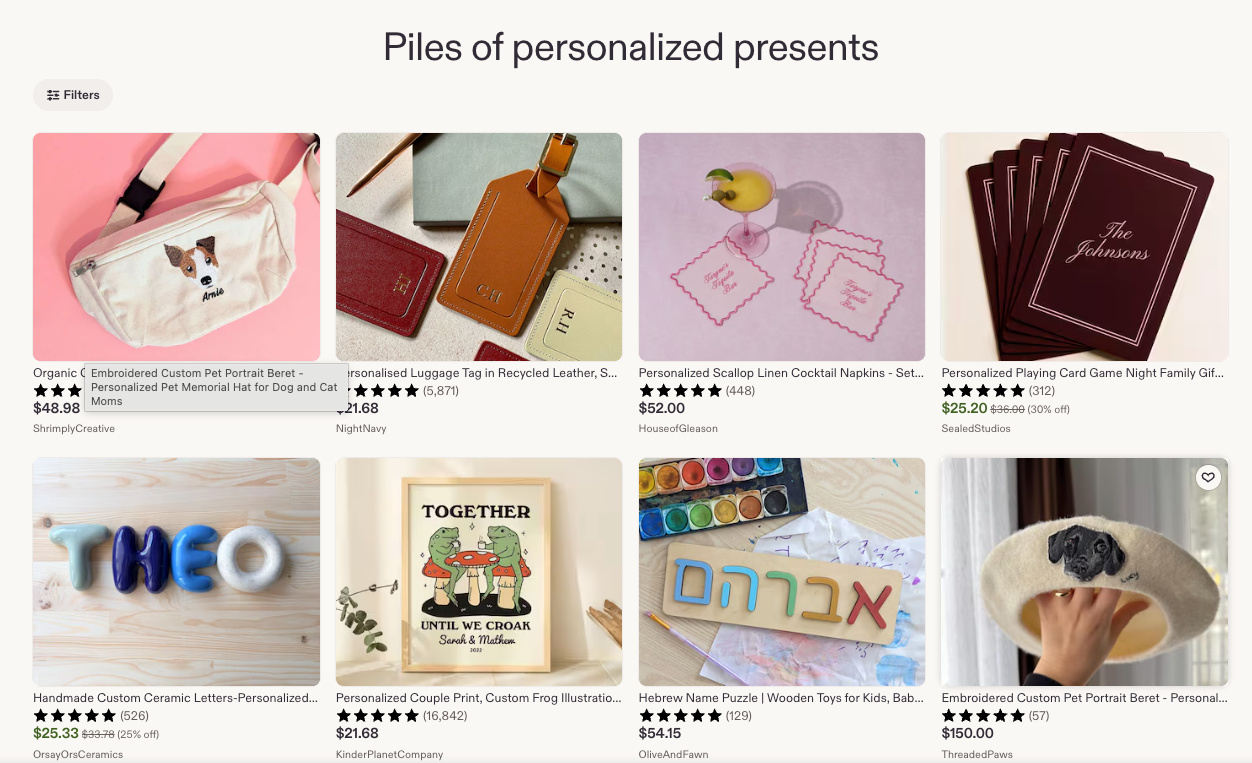
Personalized content is extremely popular right now. And generating that custom content has never been more accessible.
In books, personalized content has historically meant adding a few unique elements to preset templates. The best example of this is Wonderbly. Started in 2012 with their personalized book The Little Boy/Girl Who Lost His/Her Name, Wonderbly reports selling over 8 million books. In 2025, Penguin Random House acquired the business.
Wonderbly’s product required specific information—like the child’s name, where they live, or their birthday. The book’s print file is updated to reflect the inputs and applied to the book’s template. This model required a fair amount of technology to take in the personal details and apply them correctly to the book template.
Today, AI tools like ChatGPT or Claude let businesses offer even deeper personalization, generate files quickly, and connect to on-demand printing. Much of the complexity businesses like Wonderbly solved 10 years ago has been removed, opening the door to the generative print commerce market.
How Generative Print Commerce Works
This business model was not easy or affordable to manage until very recently. The reason for that was twofold:
- Creating personalized content required manual work to prepare and ensure quality.
- Production costs and timelines for one-off content were not feasible.
Promotional products printed at scale have been around for a long time, but monetizing them was never an option. This new business category is built on the ability to both offer individualized products and do so at scale. Generative print commerce works because both of these challenges have been (more or less) solved in recent years.
Automating Personalized Content Creation
LLMs are phenomenal at ingesting information, following instructions, and generating files. This usually takes shape as a web form or questionnaire on your site. Customers add specific details based on the kind of personalization your business offers.
Some common ones include children’s books, memoir books, astrology trackers, fitness or meal planners, and educational manuals. Customer inputs are processed by your trained LLM, and the book is built from those inputs, generating a unique file for printing.
Connecting Book Production & Fulfillment
Well-trained AIs make it fast and easy to generate personalized content. The next step requires connecting to a production partner that can print and ship the books. Because you’re creating a custom book, the print file will be unique for each order. This means your production partner needs to be able to seamlessly handle a new file for each print request.
Obviously, I’m talking about Lulu here.
Using our API, businesses route print files to our print network. The book prints and ships directly to your customers globally. You never have to handle packing or shipping books (though you should order test copies while you’re setting everything up).
The API is built such that each order looks for the print files (for interior and cover) from a location you specify. Often the files will be stored in a Dropbox or similar web-based storage tool. Your LLM generates a unique file based on individual customer input, which is then transferred from your file storage location to the printer. This enables true book-of-one printing since each print request can send a new set of files.
 Paul
Examples of Businesses in the Generative Print Commerce Market Category
I have two examples to share with you from this emerging market category. Both of these companies use inputs from their customers to generate unique, personalized books. Selling the books becomes central to their business model, ensuring repeatable income from a process that is mostly or entirely automated.
Plumastro
Plumastro’s website allows users to enter information about when and where they were born. Then the site generates a free birth chart and provides additional details like a totem animal and horoscope.
The business then provides paid offerings that expand on the free birth chart. The goal is to transition users who are drawn in by the free offering to choose one of the paid products. That includes a daily horoscope subscription and two printed books: Astrobook and Astrolove. Both editions are created using the unique details from the birth chart so that users receive a book customized to their astrological details.
My Forever Books
My Forever Books takes old text messages and formats them into a unique gift book. The technology part of this business is different than Plumastro: rather than generating unique content based on the customer’s input, My Forever Books uses existing content and formats it into a book.
The goal is to capture the conversation as a longer narrative, helping preserve memories or moments as a printed product. Alongside that, the technology needs to stay simple and scalable.
The Expanding Market for Personalized Books
Generative print commerce is all about businesses offering personalized, custom books, with the help of generative AI. The technology has matured to a point that achieving this at scale is finally possible.
While sophisticated LLMs are absolutely necessary to enable this business model, generative print commerce is about more than just custom books. It’s about simplifying and speeding up the content creation process and pairing that with print-on-demand via services like Lulu’s API to print and fulfill orders without overhead. It is the combination of these two tools that truly makes generative print commerce possible.