

Lulu Is a Technology Company
Lulu, as of 2026, is 24 years old. In the tech world, that puts us in a league with a very small number of highly successful and resilient companies. When you’ve been around this long, you learn something crucial: longevity isn’t about branding or marketing or sales. It’s about careful and calculated engineering decisions.
At Lulu, at least in our current iteration, the driving force for the business isn’t a storefront, a product, or sales efforts. Those all contribute. But Lulu has always succeeded when the focus is on the platform. Lulu is not a publisher, a printer, or a book distributor. We do those things, but as a business, what we are is a technology platform that connects creators and their audience with manufacturing and fulfillment partners. Alex Osterwalder calls this a “multi-sided platform” in his book, Business Model Generation.
That means the work that matters most is rarely flashy. We are building systems that are scalable, stable when traffic spikes, and flexible enough to adapt to unique printing, logistics, and fulfillment needs. This was not an easy task and took years of work from every part of the Lulu team to get our platform to the place it is today.
When I joined Lulu, our technology stack and code base were not-so-fondly referred to as “the big ball of spaghetti.” There were too many moving parts, too many distinct coding languages, and not enough internal knowledge about how the spaghetti worked to make changes without breaking something.
We rebuilt because we had to. The goal wasn’t novelty. The goal was a coherent platform that a team can actually run, improve weekly, and keep improving for years.
Building Lulu’s Systems for Longevity
In conversations with Bob Young (Lulu’s owner and a founder of Red Hat) over the years, one phrase has stuck with me: we have to get better at moving knowledge from one generation to the next. This issue was evident in Lulu’s code base.
The historic Lulu site was amazing for its time. In our first decade, Lulu printed millions of books for thousands of creators, helping them with distribution to retailers and, eventually, direct-to-consumer sales. But as the team at Lulu grew and shifted, vital knowledge was lost, leaving the team I took over in 2015 scattered. We worked hard every day just to ensure the health of the site, with no time to develop it further.
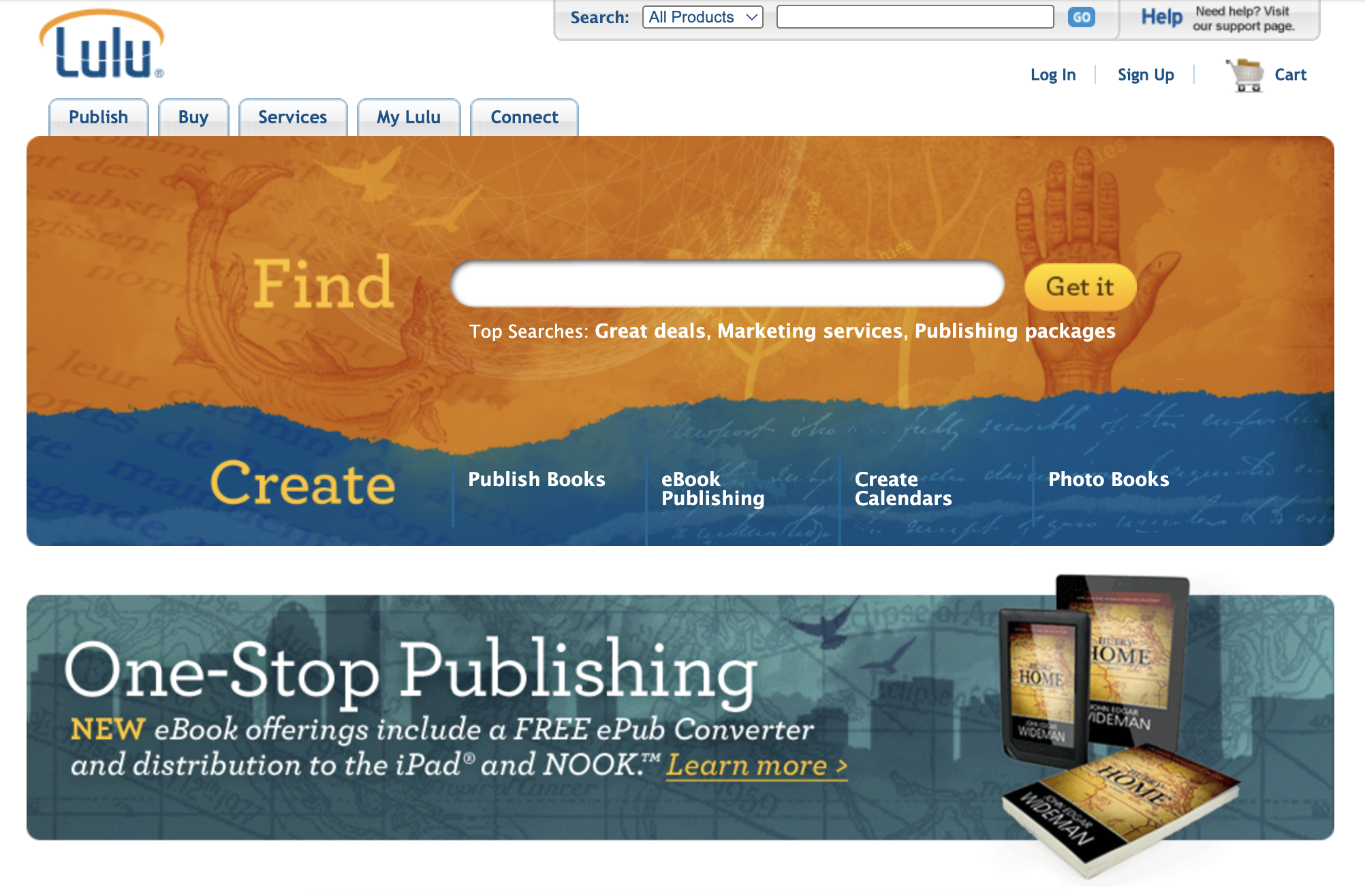
I saw—and I think everyone at the time saw this too—that to continue to provide our service, Lulu had to go all in on renewing our technology. That started with eliminating barriers.
Accessibility became a technical requirement for us. Both from a developer standpoint and for our users.
If publishing is only “accessible” when the platform is behaving, then it isn’t really accessible. And if making an update, however small, causes system instability, it’s also not accessible.
My Journey to Lulu
I’m based in Germany, and I’ve been Lulu’s Chief Technical Officer (CTO) for over ten years. I got here through one of the most unusual and lucky moments of my life: a printer I knew in the Netherlands introduced me to Lulu’s CEO at the time, and eventually we met in person. We talked for four hours about printing, technology, and the publishing industry. Not long after, he called me up and offered me a job.
Before Lulu, I was part of a company called PediaPress, where we built software to export selected Wikipedia articles and print them as a book. We’ve worked with the Wikimedia Foundation since 2007, and PediaPress still donates 10% of revenues to Wikipedia.
That project taught me a lot about publishing and digital printing at the time. Some things I learned from my time working with PediaPress:
- Printing requires special versions of a PDF file, depending on the printer and the paper
- If you can automate the file generation, you can automate the whole process
- You can never fully fix real-world problems like late shipments or print errors
- Most people who want to print and publish don’t want to learn the technical details
I took the successes and failures from PediaPress and came to Lulu with fresh eyes and a desire to find a way to improve on these processes. Many of the others in the print-on-demand, publishing, and distribution spaces, like Ingram or Amazon, were not interested in innovating, making things easier for users, or building for longevity. They focused on the bottom line, on getting users through the process and purchasing.
I wanted to build something that would stand the test of time and ensure publishing continued to thrive.
Listen to Christoph’s Interview on Publish & Prosper
The New Lulu Infrastructure: Microservices
Lulu’s platform has endured 24 years of innovation and change. When I came on board, the tech stack had become very diverse—multiple databases, programming languages, and approaches layered on top of one another. The result was a system that was difficult to understand and hard to change. The “big ball of spaghetti.”
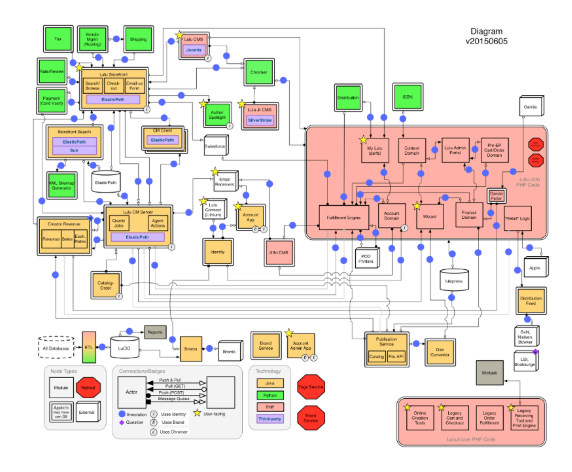
Assessing where Lulu was at the time and where everyone at the company agreed we wanted to go, I began the arduous task (along with a team of talented developers) of redesigning Lulu’s site. To ensure we had the practical control over the code that we needed, we decided on a microservices architecture.
In the developer world, microservices were very much en vogue at the time; we chose them to counteract the relative complexity of Lulu’s platform.
By using the microservices design, we were able to split the large mess of code into small services, making the platform easier to understand, easier to adapt and add on to, and far easier for our team to manage. We started implementing this in 2017.
Over the following three years, we built experimental sites like Lulu xPress and developed our Open APIs to prove the microservices architecture was right for Lulu’s future.
Relaunching Lulu in April 2020
In 2020, just as the world shut down due to COVID-19, lulu.com relaunched. This move took us completely from the old technology stack while simultaneously rebranding the site. This was a huge endeavor, unraveling the ball of spaghetti and leaving us with something more coherent and easier to manage. Despite some setbacks (we moved the launch date back three times), we finally launched in April 2020.
 Paul
Paul
Those early weeks were stressful. People still joke that they have PTSD from those days. We worked day and night, and I even slept in my office for weeks. We fixed bugs, helped users find files lost in the migration, and worked diligently to ensure every Lulu user was able to enjoy this new platform.
But the truth is: you cannot prepare for everything. At Lulu’s scale, there are too many edge cases to test every scenario ahead of time. The part I’m most proud of is how the company showed up. When things were rough, the team held together—engineering, marketing, customer service—everyone knew what was at stake.
After about three months, we got over the biggest hurdles, kept customers happy, and stabilized the platform.
It was hard, but it was worth it.
The Shiny New Lulu
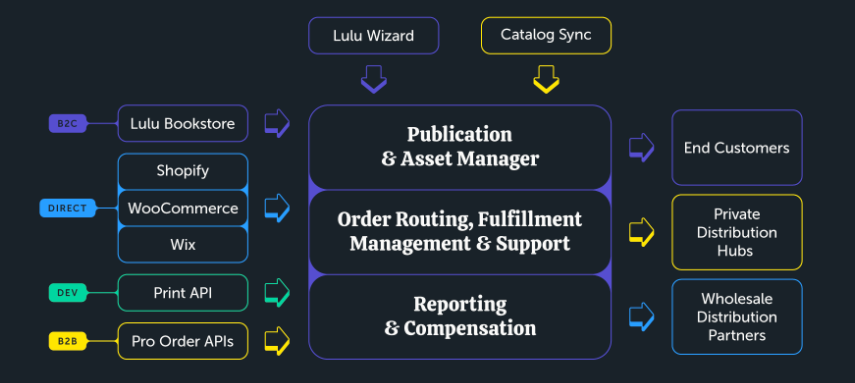
The new microservices architecture allowed us to innovate and evolve the platform in ways that were previously impossible. That includes the visible work, like quickly updating site pages or fixing bugs, but it also includes the unglamorous work behind the scenes.
To put this into perspective, with our old site, any newly released feature or fix would require a long period of testing to ensure the site could handle it. And even then, we would see issues that caused instability or actually broke the site. That would require rolling back and looking again at our update.
Since launching the updated platform and code base, we have released between fifteen and forty-five bug fixes, features, and improvements per week. Over the last five years, we’ve fixed over 10,000 bugs. This is a truly monumental change in how we manage and improve Lulu. And it’s allowed us to build hundreds of new features, without causing any issues for the users.
There’s also a business outcome that matters just as much: our infrastructure costs are now flat. We can scale up for the holiday season or when onboarding an enterprise customer without costs climbing. Just as important, we can scale back down if needed and still control our costs.

Your Free Lulu Account
Create a Lulu Account today to print and publish your book for readers all around the world
Ideas are Cheap. Execution is Hard.
I say this often because it’s true: ideas are cheap. Execution is the hard part. Because having a good idea is not a problem. Executing and getting that idea to the stage where it's really working takes much more effort.
Execution looks like our Quality Assurance team saying, “We’re going to do our best to break this,” and meaning it. As developers, we get attached to our work, much the same way an author is attached to their stories. Now, with a versatile infrastructure in place, we could truly own that work and begin the process of continuously improving and growing it.
So we ideate, and we execute. Over and over, releasing as I said, dozens of fixes and improvements each week. As a result, Lulu has become a truly robust, powerful tool for publishing, printing, and fulfilling orders. All because of the careful and thoughtful decisions my team makes every day.
Most people will never care that those decisions happened. They’ll only notice if we get them wrong.
Building to Solve Real Problems
One of my favorite examples of “problem first, tool second” is the Order Import tool.
It came out of an idea I had from my earlier PediaPress work. There’s an organization called Humble Bundle that wanted to donate to Wikipedia, and they approached me to help create a few books. They had over 2,500 supporters for that fundraiser, and I had to send everybody the right book. It was a huge pain. To handle the problem, I had to write programs to use Lulu’s Print API. Better than doing it manually, but still a large amount of effort.
That’s right, I had to review, process, and place all 2,500+ orders myself.
That pain is a signal. I felt the frustration and annoyance that comes with that much tedious work. And if it was a headache for me, I was certain it was just as much of a headache for conference organizers, reunion planners, authors running a pre-sale, and any business trying to ship numerous books to numerous people at once.
So we decided to fix this issue for our users. I envisioned a simple path:
- Upload a spreadsheet with your customer’s shipping info and the books they purchased
- We verify those addresses and order information
- You make a one-time payment for all of the orders
Since releasing the Order Import tool, it’s become one of the fastest-growing and most popular additions to Lulu since we launched Lulu Direct.
Pet vs. Cattle: The Clearest Test of a Tech Company
In technology, there’s a notion of pet versus cattle.
Your computer at home is your pet: it’s specialized, personalized, and meant to fulfill your specific needs. But at Lulu, we treat the infrastructure like cattle. Likewise, for the books we print. Everything goes through the same standardized process. This ensures quality and consistency for any volume, be it a single book, a hundred books, or thousands.
That’s one of the most important criteria for a tech company’s success: building a process that doesn’t require adding more people as volume grows.
You can see it in how customers use our platform. Some years ago, an artist, Michael Mandiberg, wanted to print Wikipedia (yes, all of it at the time). We helped him prepare files, and he uploaded nearly 7,500 volumes with a script. And last year, a user uploaded 45,000 personalized Sudoku books. This caused an obvious spike in our data, but it didn’t disrupt the Lulu as a service.
That’s the goal: repeatable processes that keep working when creativity shows up at scale.

Sell Your Book, Your Way
Sell books on your Wix, Shopify, or WooCommerce website with Lulu Direct.
Or use our Order Import tool for your next book launch.
Looking to Lulu’s Future: Flexibility at Scale
Going forward, I foresee a future where Lulu acts as a complete publishing hub: your Lulu connection opens up access to everything our print and fulfillment network offers.
For example, we currently offer sixteen trim sizes. But some of our printers offer many, many more options. As we continue to develop Lulu, there will likely come a time when you can request a specific size and set of book specs, routing that order to the specific printer that can handle those projects.
Lulu stores your files, validates them for printing, enables ordering, and helps manage fulfillment, while you're in control of routing decisions. Like everything we do at Lulu, the goals stay the same:
- Flexibility
- Efficiency
- Consistency
- Control
Organizational structure mirrors the organization and infrastructure behind that company. This is called Conway’s Law. Seeing how Lulu has evolved (thanks to Lulu’s Marketing team's efforts to share our brand story) is fairly easy. But seeing how that evolution is mirrored and often informed by our tech stack is harder to notice.
The work we do in the background is what makes Lulu run smoothly, leaving us able to innovate and improve. And we are, every week, with every new update and release, improving a small piece of the platform without causing any disruption to creators like you.
Despite early perception, Lulu has always been a technology company. We understand creators and businesses need stable, consistent, and reliable printing and fulfillment. So we keep building publishing infrastructure that stays accessible as the world changes, using microservices to make adaptation fast and seamless.