Sell Books Without Sacrificing Brand Control
Take a moment now and look at the books on your bookshelf. Spines out, titles running down them. And there, usually at the top or the bottom, is a publisher logo. Random House, Tor, Bantam—these little indicators of the publisher are so common that they’ve become ubiquitous. Just a part of a book cover, right?
Pull one out and flip to the back cover. You’ll see a little blurb, almost always next to the barcode at the bottom. It likely has more info about the publisher, maybe even a URL to their main site, and a callout for the cover artist.
This is important for branding efforts publishers do to build customer recognition. Brand consistency plays a huge part in business growth. If you read ten books and you see the same publisher logo on the spine of seven of them, you’re likely going to want more books from that publisher. Right? Likewise, if you read something and didn’t care for it, you might shy away from other books from that publisher.
Even in a time when browsing the bookstore is less and less common, your book’s cover is still a key marketing asset.
So why would you let some other business steal your real estate?
Brand Consistency Is a Must for Growing Businesses
I wrote that H2 and stared at it for a long time. Because I’ll be damned if it doesn’t read like something ChatGPT would churn out. But no, that buzzword-rich phrase is all me.
Anyway, it’s true. Branding is trust. You trust Nike to sell you high-quality sneakers. You trust Apple to offer sleek, easy-to-use tech.
That trust starts when each company delivers on its promise. But it persists because we begin to associate that brand with that promise. Your brand is what you use to associate a positive user experience or quality product with your business.
For books and publishers, branding is often less emphasized. There are dozens of fantasy publishers out there, and every one of them has published great books and mediocre books. This was true—in the age of traditional publishing.
But we’re evolving. And that branding is more important now than ever before.
Think about the way you would buy a book in 2010. First, you’d be on Amazon. So you’re already getting slapped with their branding. Then you get the book, and it’s got the publisher's branding on the cover. And on the description. You would see the author’s image on the sales page, but it’s tiny. In this example, the person who actually wrote this book is, at best, third in line for branding.
Now think about how independent authors operate in 2026. They’re building a following for themselves, usually through social media or email subscribers. They’re sharing content through owned channels. And what about if you’re a business that relies on selling books? Being in third place in the branding race is not at all ideal.
How On-Demand Production & Fulfillment Are Changing the Game
In the last ten years, we’ve experienced a monumental, though somewhat gradual, shift in the way content, services, and products are shared and sold. Historically, anyone who created anything relied on a retailer of some kind to distribute that product. This created a situation where people who had content to share were reliant on rented land to get exposure and earn money.
Thanks to platforms like Shopify and Lulu, you can take control and own your content distribution. Not to mention capturing customer data in the process.
Print-on-demand was initially a focus for individual creators. It’s affordable, with very low cost to entry, and gives anyone access to print and sell books. Now, as digital printing matures, we’re seeing businesses and publishers taking advantage of this method.
Automated printing is a lifesaver for publishers’ backlists. Custom integrations, particularly when paired with AI tools, have led to an entirely new industry built around offering one-off, custom books.
Availability and personalization are both reasons print-on-demand has become such a popular way to sell and dropship products. But another crucial, though often less acknowledged, factor is inventory. For publishers, inventory costs and management are a constant concern, particularly for backlist titles. On-demand production means no warehouses, no handling, and no costs that come with them.
How On-Demand Production Enables Brand Consistency
Okay, so I’ve outlined why print-on-demand is such a powerful method for growing a business, and the inherent problems with relying on another brand to sell your products. Now let’s bring it all together.
The bottom line is: you don’t need retailers to sell your book. Which is great, cause Amazon, and its ilk are becoming less and less appealing platforms.
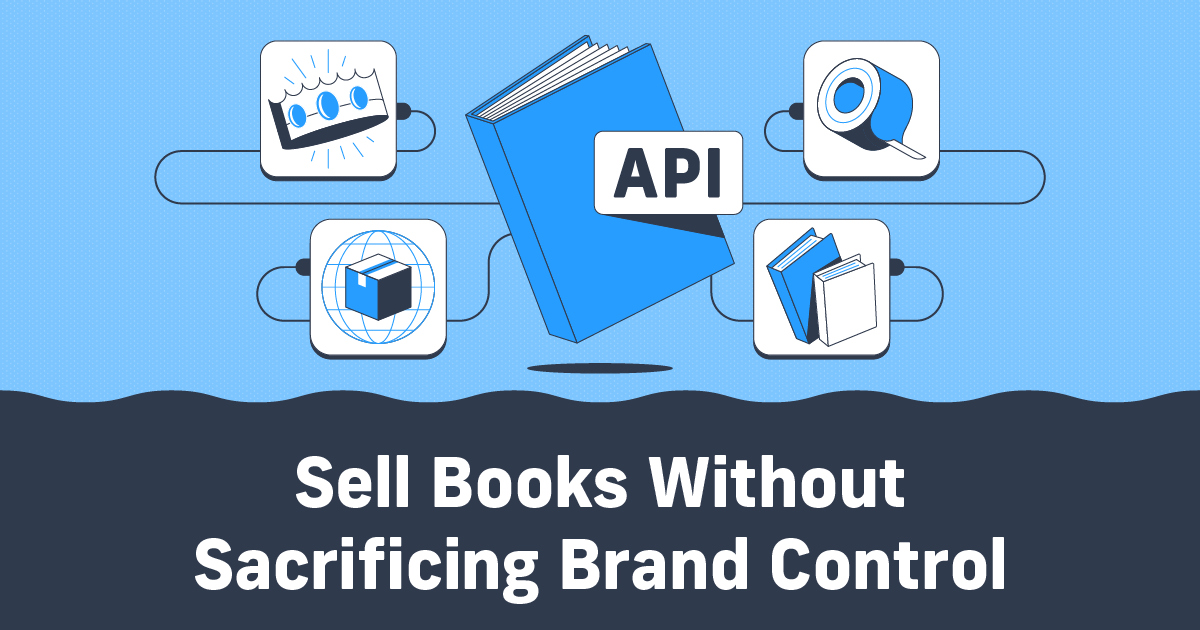
With today’s tools, you can create your own storefront and product catalog pretty easily. With your books uploaded to Lulu, our APIs and direct ecommerce integrations (with Shopify, Wix, and WooCommerce) connect our powerhouse print-on-demand and fulfillment network to your store. All you need are the customers.
This is the backbone of direct-to-consumer retail, a growing trend among creators and businesses. You get control over your products, more data than a retailer would ever imagine sharing, and you’ll have far better margins because you’re not splitting your revenue with a retail site.
Finally, you’ll be able to center everything you do around your singular brand. Here’s how.

Sell Your Book, Your Way
Sell books on your Wix, Shopify, or WooCommerce website with Lulu Direct.
Or use our Order Import tool for your next book launch.
White-Label Printing: Keep Your Brand Front and Center
This is, quite possibly, the most important thing you can do for brand consistency with your products.
You’ve got your logo and business name on your site, in your book, in your emails, and you’re using them on your social media profiles. Why would you want some other company’s logo on the packing slip when they get your book?
When we built Lulu Direct to simplify ecommerce integrations, we asked a lot of booksellers and creators what they needed most.
The list was long. But one thing that popped up often was branding.
Digging into this, we discovered that a lot of people using Lulu to sell books wished they could remove our branding from their packing slips and present their own. So we built white-labeling into Lulu Direct.
Presenting your own brand on your customer’s packing slips is part of delivering a seamless shopping experience that keeps the focus on you and your brand. It also helps build and reinforce brand recognition, something important if you want readers to suggest your book to their friends or otherwise spread the word about your works.
This is how individuals and businesses create a holistic brand experience, a proven tactic for direct-to-consumer sellers.
Customization Features That Protect Your Brand Identity
Along with helping you provide a cohesive brand experience based entirely on your brand needs, Lulu also provides a range of product customizations that further ensure you’re putting your brand at the center of your business.
That means you can define a distinct size, ink, paper, trim, and layout for your books. If you use that same format for every book you produce, you’ll develop a signature look or style that readers will instantly recognize.
Creating your books from your files means you can align those books with your digital branding. Use the same color palette, apply your logo, and add your brand information to the cover and interior, all as you see fit.
Along with that, using our APIs allows you to request a unique printing (called a ‘print job’) every time an order is placed. Unlike the traditional Lulu system, where you upload a single interior and cover file to be used for every order, our API connections allow you to specify a unique file.
The benefit of this is the option to offer customization and personalization. This opens a whole new world of possibilities. Some companies, like Adorabooks, use custom printing to offer unique children’s books. The possibilities are pretty much endless, though, with the right tools on your site to gather information and generate the personalized file for printing.
Personalization, especially in an on-demand world, is likely the next big thing in dropshipping products. Lulu makes sure it's an option for you and your brand.
Bundling and Product Variants for a Cohesive Brand Offering
Another important way to keep your brand in focus is to ensure your site and product pages are cohesive. Lulu offers two options that are big for streamlining your product catalog:
Both of these features are pretty common ways to upsell and cross-sell that traditional retail sites have utilized for years. Here’s a pretty common example from Bookshop.org.

Each version—hardcover, ebook, and paperback—is a product variant. This cuts down on store pages since you can offer all versions of your book on a single page. Which is a big deal when you’re running a business with numerous products to sell or if you’re a solo creator trying to manage your entire business by yourself.
Similarly, you can create bundles of multiple products to increase your order value and entice readers. Think about the trilogy sets of books you see in bookstores. Or maybe you bundle a short story or snippet from a new book along with a popular product.
Both variants and product bundles might seem more like marketing than branding, but it’s crucial to have these offerings to provide a simple, cohesive, and on-brand experience for your customers.
Scaling Your Business Without Losing Brand Control
Lulu’s inventory-free model with global distribution and automated workflows might sound like a very technical platform. At the end of the day, what we do is print and ship books. Scalable fulfillment is a challenge we solve for growing businesses.
If you’re selling books and find yourself at a point that demands growing to meet demand, brand control is an easy-to-overlook pitfall. What I mean is that it is easy to get into the weeds of technical work to grow your business. That work is time-consuming and can be tedious. Like building out a website or developing new products.
Your brand can get lost in there.
This concern is one we’ve heard from booksellers a lot in the last few years. And it’s the reason we’ve built in tools like automated white-label shipping to help you keep your brand front and center.

Your Free Lulu Account
Create a Lulu Account today to print and publish your book for readers all around the world