
Choosing the Right Direct-to-Consumer Solution for Selling Your Books
Lulu offers a variety of different ways for authors, creators, and businesses to distribute their books, including third-party retail options and direct-to-consumer sales solutions. For those interested in selling direct, there are two distinct options available: our Lulu Direct plugins and our suite of API integrations.
Creators hosting their stores using Shopify, Wix, or WooCommerce for WordPress can use our Lulu Direct solutions. While these integrations do require some minor setup, they are relatively plug-and-play ways for creators to build straightforward ecommerce stores.
Entrepreneurs interested in a completely custom ecommerce solution can access our open-source APIs. Developers can build integrations to connect directly to our global print and fulfillment network, and create custom workflows that provide unique products and shopping experiences for their customers.
The Benefits of Selling Direct
We’ve spent years espousing the benefits of selling direct-to-consumer, soapboxing on YouTube, on the Publish & Prosper podcast, at in-person events, and even right here on this blog.
It all ultimately boils down to this: Selling direct gives authors, creators, entrepreneurs, and businesses complete control over their brand, their customer experience, and their customer data.
Whether you’re using one of the three ecommerce plugins, a custom API integration, or even manually fulfilling orders from home, there are some universal benefits of selling direct:
- Gain access to your customer data
- Keep 100% of your revenue
- Eliminate inventory and up-front costs
- Control your branding with white-label fulfillment
- Automatically scale your production and fulfillment as your business grows
- Access Lulu’s global print network to reach customers worldwide
The Differences Between Lulu Direct and the APIs
Of course, there are a few key distinctions between the Lulu Direct plugins and the API integrations, which means there are distinct advantages to each.
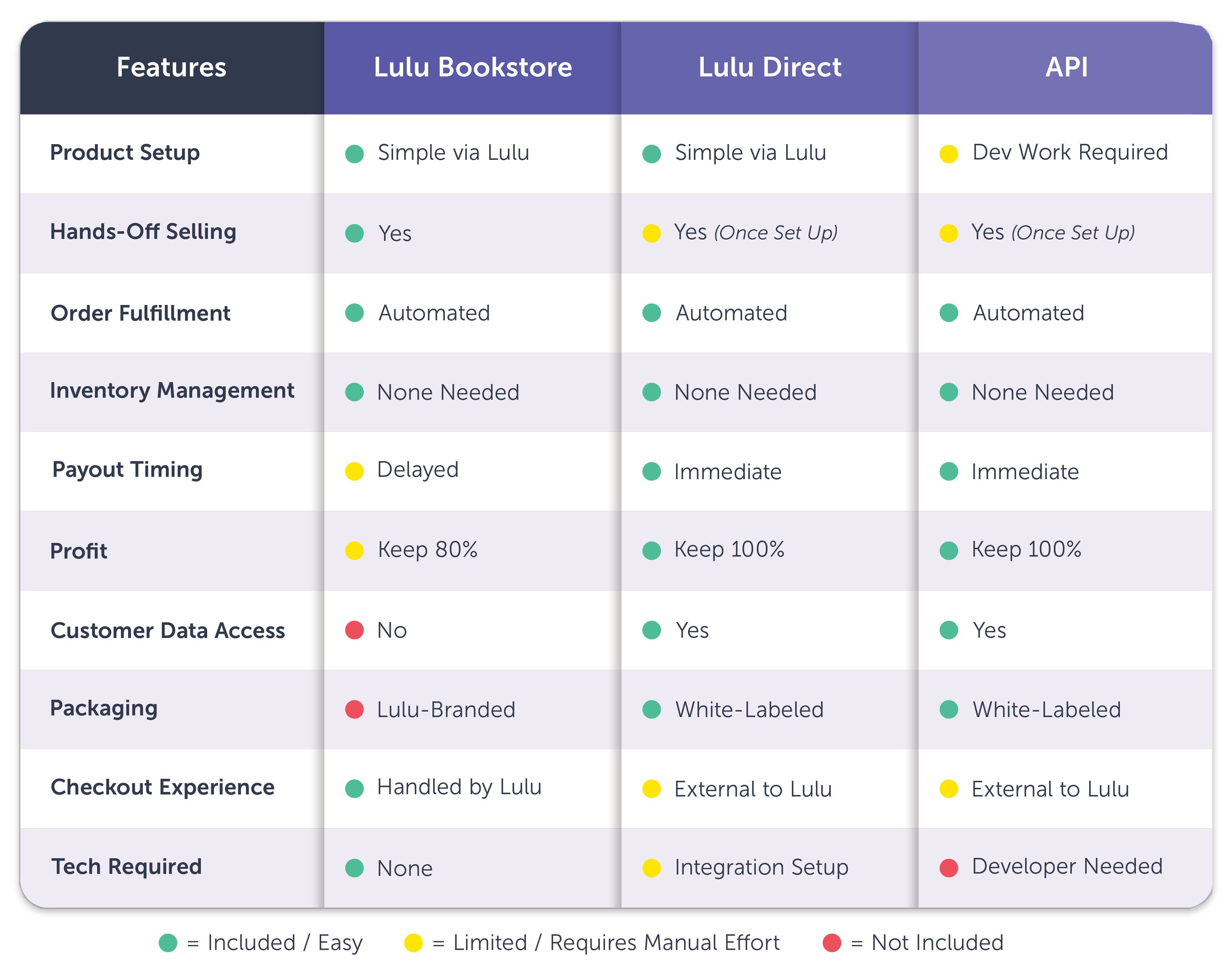
This chart highlights some high-level differentiators between selling on the Lulu Bookstore, via Lulu Direct plugins, or building API integrations, but let’s dig a little deeper into some additional distinctions and benefits.
Solution Integration & Setup
Realistically, both direct sales solutions require some up-front effort to set up and launch a store.
All three Lulu Direct plugins can be integrated into any existing website that supports Shopify, Wix, or WooCommerce, but the hard work is already built into the apps. We’ve created a full knowledge base of guides and step-by-step tutorials to help you set up your Lulu Direct store, and offer Direct support for anyone that needs a little extra help.
An API-powered store can be hosted on any website, not just limited to the three Direct options. However, the APIs are not plug-and-play solutions; even the most straightforward store setup will require backend developer work as part of the setup process.
Lulu provides everything you or your developers need for API integration, including complete documentation, a sandbox environment for testing workflows, and a dedicated knowledge base with resources and guides. While we do have an in-house support team to help API customers, we are not able to build or complete the integration for you.
Personalized Products
Every year more and more creators and business owners are offering unique products to their customers and fans, and we love to see it.
With Lulu Direct, creators have some flexibility within their product offerings by creating product bundles, offering different variants, and even using additional ecommerce solutions to sell other POD products in tandem with their books.
But for entrepreneurs looking for more robust customization features, like creating books with modular content based on individual customer needs or adding unique details like reader names and physical descriptions to the book, there’s only one solution.
Savvy developers can use the API integrations to build out workflows that automate customization and personalization for individual print projects. For example, see how Joshua Zinkovsky uses custom API integrations to power My Forever Books.
Automated Production & Fulfillment
Truly determined entrepreneurs can always find creative ways to create and sell custom products, fulfill orders, manage pre-order and crowdfunded campaigns, or start a recurring subscription service. For those without the knowledge or resources to integrate custom workflows, those creative solutions are usually manual production and fulfillment. But manual fulfillment isn’t scalable, and ultimately any successful business will find itself unable to keep up with demand.
Lulu users can access solutions that can help streamline, or at least mitigate, some of those fulfillment pain points. The Order Import tool is a great solution for fulfilling pre-orders, crowdfunded campaign rewards, or recurring subscriptions. While it still requires some manual effort by the store owner, it’s a much lower lift than manually placing or packaging orders one by one.
With the API integrations, and with help from an experienced developer, you can implement completely automated and scalable solutions to help fulfill personalized / customized projects, drop-ship pre-orders or recurring subscriptions, create unique product bundles, and scale dynamic pricing or unique features for custom orders—if you can think it (and, more importantly, if you can code it), you can automate a solution using the APIs.
Store Management & File Storage
This may seem like a minor detail, but a major distinction between Lulu Direct and the API integration is how you access both your store and your project files.
Lulu Direct storefronts and all associated files are managed from your Lulu account. Just log in at lulu.com for complete access to your Lulu Direct Dashboard. You’ll also upload your print-ready PDF files for your products straight to your Lulu account, where you can manage Direct, third-party retail distribution, self-purchases, and anything else you need.
The API suite, on the other hand, exists in an adjacent ecosystem. Your Lulu account credentials will still give you access, but your API dashboard, sandbox environment, and everything you need to build and manage your integrations are hosted at https://developers.lulu.com/home instead of at lulu.com.
API users will also need to manage their project files separately from their Lulu accounts. The API payloads pull print files directly from your platform or a file-sharing platform like Dropbox, not your Lulu account. You’ll need to host your print-ready PDFs separately, and share the distinct URLs when creating a print job request.
Which Direct Sales Solution is Right for Me?
Ultimately, the best solution for you depends on your specific needs, long-term goals, pain points, and available resources.
If you are…
- Already hosting your website (or building a new website) on a platform that supports Shopify, Wix, or WooCommerce integrations
- Interested in selling direct for benefits like revenue and customer data
- Not planning to sell unique, personalized, or custom products
- Just getting started, but want a scalable fulfillment solution until you have a better understanding of your specific business needs
Then Lulu Direct is a great way to power your brand’s ecommerce needs!
Whichever solution is right for you, we’re here to help. Learn more at any of the resources linked throughout this post, and be sure to subscribe to our email list to have direct sales resources sent straight to your inbox!